




Our history



THE TRUE AND SURPRISING STORY OF VAL-JALBERT
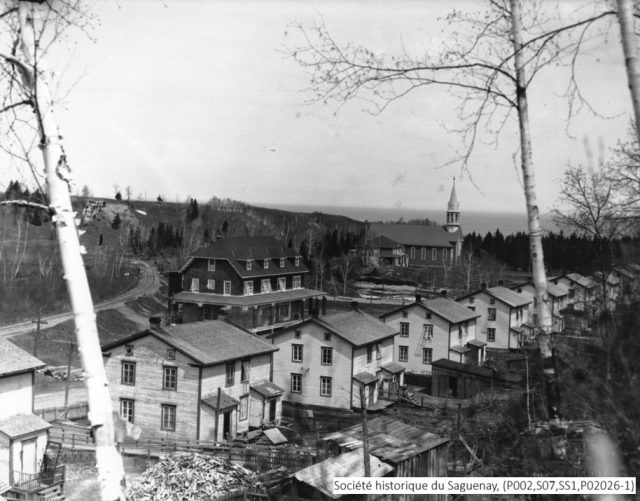
The village was founded in 1901 to house the pasta mill and the people who worked there, as well as their families.
This type of village is called a “company village” because a company owned the site and the buildings. When the company closed its doors in 1927, its residents abandoned the place.
The emergence of a site with great potential for a pulp mill ─ 1901-1903
When the Ouiatchouan Pulp Company was founded in 1901, the project’s founder, Damase Jalbert, began construction of a plant—a mill—that would begin production a year and a half later.
Pulp mill ─ 1901-1903
At the end of the 19th century, the pulp and paper industry was experiencing a rapid growth, particularly in the United States and Europe. It was against this backdrop of strong demand for paper thatDamase Jalbert*1 began construction of a pulp mill located on the riverOuiatchouan*2, at the foot of the falls, near Chambord in Charlevoix Township in the Saguenay–Lac-Saint-Jean region. To meet demand from the United States and Europe—and recognizing the region’s immense forestry potential— Damase Jalbert, after raising the sum of 15 000$ from convinced investors, purchased a parcel of land in the name of the trustees of the Ouiatchouan Pulp Company to carry out the future project. The new company was incorporated on April 27, 1901.
On this plot of land, there is already a house, a flour mill, and some machinery. As of 1901, construction work on the new factory and the future village gets underway. About fifty workers are busy leveling the ground to build a factory measuring 200 feet (66 meters) by 60 feet (20 meters). A one-mile-long railroad track is laid to connect the pulp mill at the base of the falls to the village of Chambord. A dam 28 feet (9 meters) high, as well as a stone wall 370 feet (120 meters) long, were erected. The industrial complex also included the installation of a dynamo that would later supply electricity to the village, as well as a sawmill. Eighteen months later, the mill began operations, and during its first winter (1902-1903), it ran smoothly. The employees were busy producingmechanical wood pulp*3.
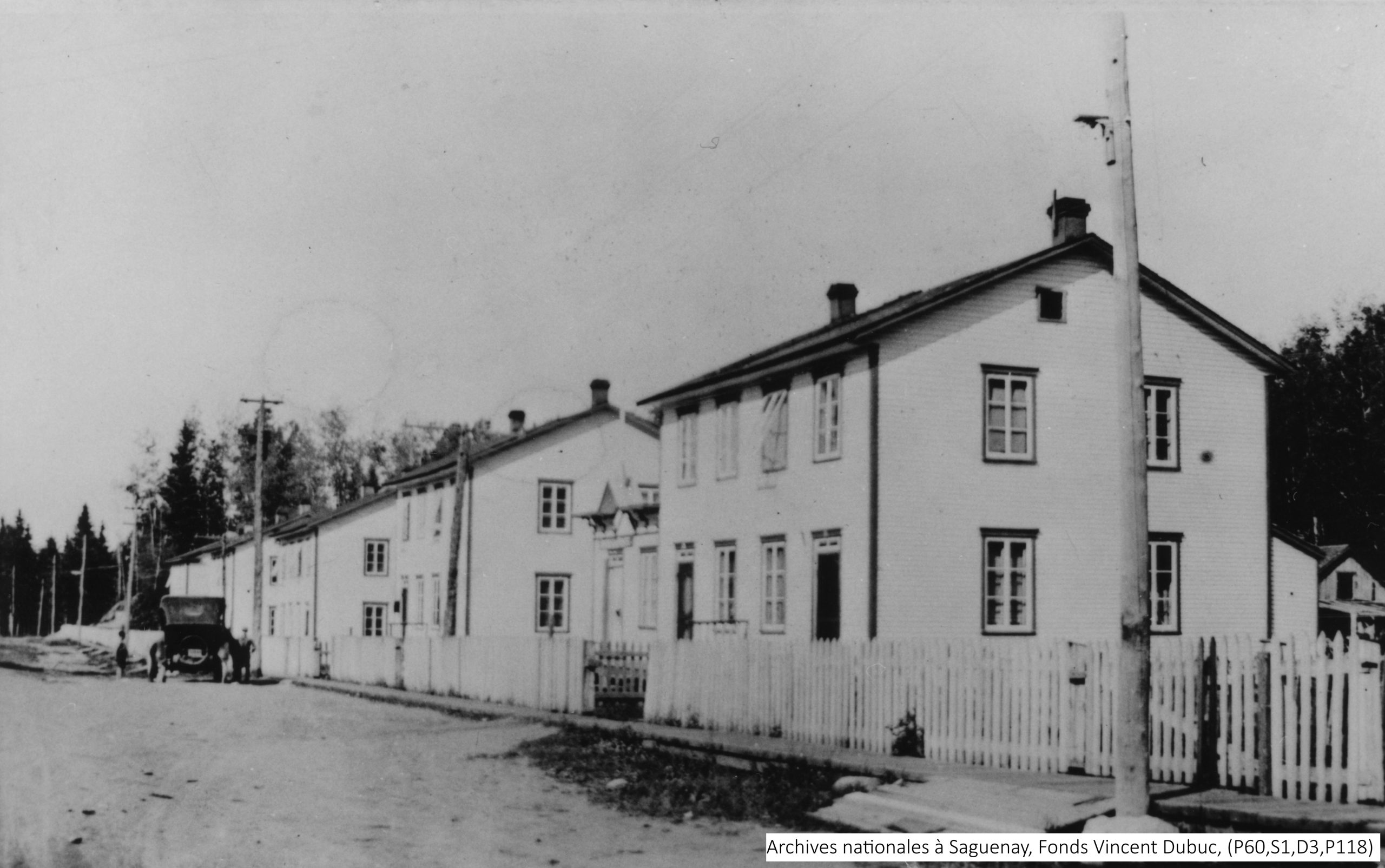
To accommodate the employees, the first residential area was built on Saint-Georges Street in 1901. The new village was named Ouiatchouan. Four semi-detached houses (three for the workers and one for the foreman), a boarding house, and a small hotel were the first buildings in the new village. The foreman’s house and one of the workers’ semi-detached houses still stand today, as do the remains of the chapel dedicated in 1903. Damase Jalbert, who died on March 31, 1904, is considered the founding father of the factory village that would later bear his name.
*1-Damase Jalbert : Born in 1842, Damase Jalbert was originally from Cap-Saint-Ignace in Montmagny County. He began his career as a navigator aboard ships carrying lumber. After a brief stay in the United States and then in Kamouraska as a merchant, he settled in Lac-Saint-Jean, in St-Jérome-de-Métabetchouan, to run a cheese factory. He later entered the lumber industry by purchasing a logging concession at Lac des Commissaires and then a small sawmill at Lac Ouiatchouan, near Lac Bouchette. Since the lumber trade was very prosperous at that time, he undertook the construction of a pulp mill on the Ouiatchouan River in the early 20th century. Damase Jalbert had 8 children.
*2-Ouiatchouan, meaning:
In the Cree language: WIAW (crooked), DJIWAN (current), WAWIYATJIWAN (rotating current), WIADJIWAN (clear stream).
In the Montagnais language: UIATSHOUAN (waves, waterfalls, white-foaming rapids), OUIATCHOUAN (where you can see the waterfall).
Ref.: PROVINCIAL TOURISM OFFICE. “On the Roads of Quebec.” Department of Public Works, November 1929, pp. 508-510.
*3-Mechanical wood pulp: A manufacturing process made from wood and water that involves five steps. First, thedebarking which involves removing the bark from the logs using debarkers. The logs are then ground using sandstone millstones and reduced to fibers. This is the defibration. At this stage, the fibers are mixed with water to form the pulp. Next comes the sieving and precipitation where, the pulp is filtered into tanks and carried by strong water currents over tightly stretched wool blankets that retain only the fine wood particles. These particles are then wound around a large cylinder, cut, and stacked into sheets. The process continues with the pressing. The leaves are placed on a wire mesh and then pressed to remove as much water as possible. Once dried, the leaves are packed into bundles ready forshipping. All that remains is to transport the bales by train to Chicoutimi and then by ship to major cities.
The First Setbacks at the Val-Jalbert Mill ─ 1904-1909
After Mr. Jalbert’s death in 1904, American investors acquired the company, which was renamed the “Ouiatchouan Falls Paper Company.” The new owners, seeking to expand their operations into paper production and wishing to carry on the founder’s work, expanded the village of “Ouiatchouan Falls” on Saint-Georges Street by adding five new duplexes. However, in 1907, the American company also began to experience serious financial problems. These were due to debts accumulated to maintain production as well as to the cost of the new construction. These problems threatened the company with bankruptcy. It was then that Mr.Julien-Édouard-Alfred Dubuc*1, managing director of the Chicoutimi Pulp Company, nicknamed “the pulp king.” On behalf of the Chicoutimi Pulp Company, he acquired an initial block of shares in the Ouiatchouan Falls Paper Company, of which he was the general manager, and in 1907 became general manager of the Ouiatchouan pulp mill. In 1909, the Chicoutimi Pulp Company acquired a majority of the shares, and the acquisition of the remaining shares continued until 1914.
Upon his arrival in 1907, Mr. Dubuc wanted to double the pulp mill’s production capacity and also hoped to begin construction of a large-capacity paper mill, but this latter project never came to fruition. From 1907 to 1909, he expanded the village further by adding a hotel (guesthouse) and two more duplexes, as well as the water system and sewer system.
*1- Julien-Édouard-Alfred Dubuc:
The eldest son of J.A. Dubuc, a merchant from Sherbrooke, J.E.A. Dubuc was born on January 21, 1871 in Saint-Hugues, in Bagot County. After completing his business studies in Sherbrooke, he worked for the Canadian National Bank in that city until 1892, then established the bank’s first branch in Chicoutimi. In 1897, he joined the Chicoutimi Pulp Company as general manager. He worked for 25 years in the pulp industry in the Saguenay region. He oversaw numerous projects, such as the construction of the Roberval-Saguenay Railroad, the founding of the Ha! Ha! Sulphite Company in Port-Alfred, and the acquisition of the Val-Jalbert mill by the Chicoutimi Pulp Company. He also acquired a chemical pulp mill in Chandler. In 1923, he resigned from the executive committee of the Saguenay Pulp and Hydroelectric Company and subsequently left for London, England, to work as a consultant for Becker and Company, his business partner in the Port-Alfred pulp mill. When the Becker Company went bankrupt, it took the Port-Alfred mills and the Chandler mill down with it. After his return, he began a political career as an independent Liberal member of Parliament for the federal riding of Chicoutimi, and later became mayor of Chicoutimi. He died at the age of 76 on October 27, 1947. He had 15 children, 5 of whom survived him. He was married to Anne-Marie Palardy.
The Golden Age of the Mill and the Village of Val-Jalbert ─ 1909-1924
The expansion of the “Moulin Saint-Georges” pulp mill: To increase its production capacity, the Chicoutimi Pulp Company (CPC) began, starting in 1910, various expansion projects, including the construction of a stone millhouse designed to house 3 large turbines. Next, a stone-and-cement annex with a reinforced concrete floor was added to house paper machines, hydraulic presses, pumps, and screens. Four years later, on the west side of the mill, a room for manual debarkers and the digester was built. Then, in 1916 et 1917, the original wooden section of the mill was clad in stone. Some remnants of this equipment and machinery still exist in the mill today.
Urban development: In parallel with the plant’s expansion work,the village*1, owned by the CPC, adopted an urban development plan led by Mr. Dubuc, which served as a model for surrounding villages. On the east side of Saint-Georges Street, new houses began to appear, and barracks were built along the river to house new workers. In 1910, the first church and rectory were built on the west side of Saint-Georges Street. It was consecrated in 1911 with the arrival of the first parish priest, Father Joseph-Edmond Tremblay. The second street, Saint-Joseph Street, was established shortly before 1913, along with more semi-detached houses. Three other streets were opened in 1915 (Sainte-Anne, Dubuc, and Tremblay). That same year, a school board was established, as well as a convent school. Development of the working-class neighborhood on the plateau began in 1917 to provide housing for workers and continued until 1919. Another street (Labrecque) will be added to the neighborhood, featuring ten houses with concrete foundations. Finally, to complete the residential development of Val-Jalbert, ten morehouses*2 duplexes will be built by the CPC in 1923-1924. In all, 40 occupied houses will be built in the village of Val-Jalbert.
Daily life for the village residents: Under Mr. Dubuc, the village was equipped with public fountains and wooden sidewalks. The tree-lined main street was paved with macadam. Every street in the village has street lighting, making the village a model of modernity in a traditionally rural setting. Every family has running water, sewer service, and electricity, and heats their homes with wood-burning stoves using wood scraps from the factory. The day begins very early with the housewife milking the cows, then the husband starts his shift at 7:00 AM, and the children must be at school by 8:00 AM. All shopping is done at the general store (at the Val-Jalbert Hotel) on Saint-Georges Street. The butcher shop is located right next door, and the post office is across the street. Women have few social contacts, while men enjoy more sports and recreational activities. For medical care, people must travel by train or car to Roberval. The Spanish flu epidemic of 1918 claimed 14 lives, particularly among pregnant women and children.
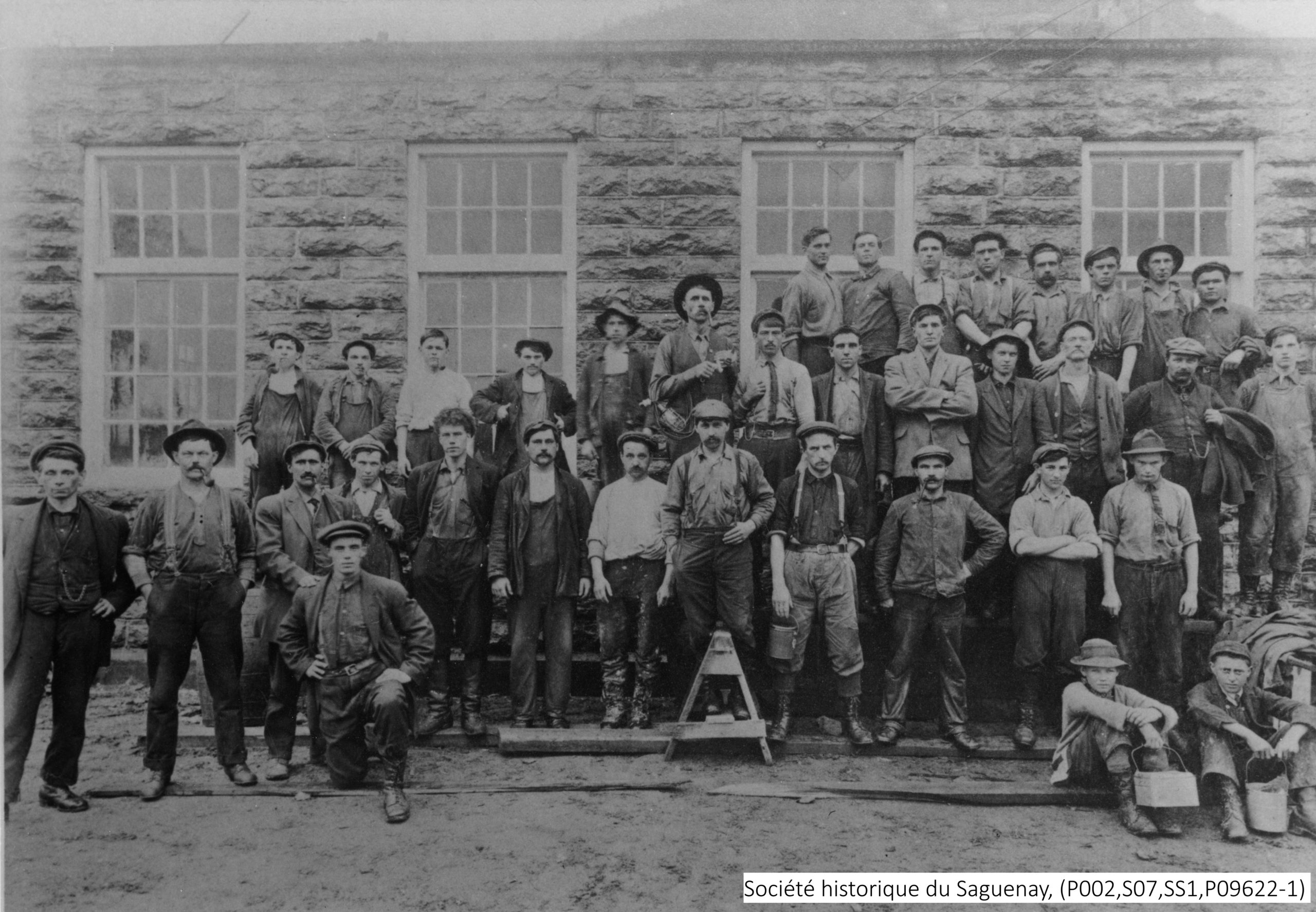
Life at the mill: Work at the mill is divided into three shifts, six days a week. The mill is damp and noisy. Teams of employees rotate through all shifts across various sections: at the grinding wheels, the screens, the machines, maintenance, lubrication, cleaning, etc. A foreman supervises the employees. Some of them work on logging sites in the winter preparing the wood that will be turned into pulp during the summer.Employee wages*3 as are working conditions, are considered the best in the region. The employees unionized in 1913, joining the Fédération Ouvrière Mutuelle du Nord (FOMN), a Catholic union.
*1-The village: Founded at the same time as the pulp mill in 1901, the village was known as Ouiatchouan until 1913, when its name was changed to 1909 and renamed Val-Jalbert. It became a parish in 1910 under the patronage of Saint George, with 40 inhabited houses at the time. It became a municipality in 1915. The first mayor from 1918 to 1921 was Mr. Wellie Fortin. In 1914, the village had 550 residents; in 1920, 600; and in 1926, 950. Then, in 1931, the village had only 50 residents. Anecdote: In 1919, the Val-Jalbert inn burned down, but it was immediately rebuilt. In December 1923, the village was threatened by a major flood. Father Tremblay walked along the river carrying a statue of the Virgin Mary. The water stopped rising.
*2-Houses in 1919: On a frame of spruce studs, tongue-and-groove boards were installed on the exterior at an angle to the vertical, followed by a layer of asphalt-coated paper, and finally cedar shingles. In later constructions, the cedar shingles were replaced by clapboard. Toward the interior, there are first tongue-and-groove boards placed horizontally, followed by a finish of thick waxed cardboard.”
Ref.: “Estimate and description of the work to be performed and materials to be supplied for the construction of ten houses to be built in Val-Jalbert” (A.N.Q.C., Mgr Victor Tremblay Collection, file 756.5); PICARD, François. Val-Jalbert, an Open-Air Museum: Analysis of the Site’s Archaeological and Ethnographic Potential. June 15, 1982, 29 pages (Val-Jalbert Documentation Center, file #172).
*3—Average employee salaries (between 19 and 15 et 1925):
For a week of 60 hours:
Table saw: between $17,00$ and $18,30$
Wood storage room: between $17,70$ and $21,25$
Mill: between 16,40 and 20,20
Repair: between $1 and $2
Workshop: between 20,40 and 23,00
Ref.: “Wage scales at the Saint-Georges plant, 1915-1925” November 7, 1925 (A.N.Q.C., Mgr. Victor Tremblay Collection, file 756.3)
The Val-Jalbert Collapse ─ 1923-1927
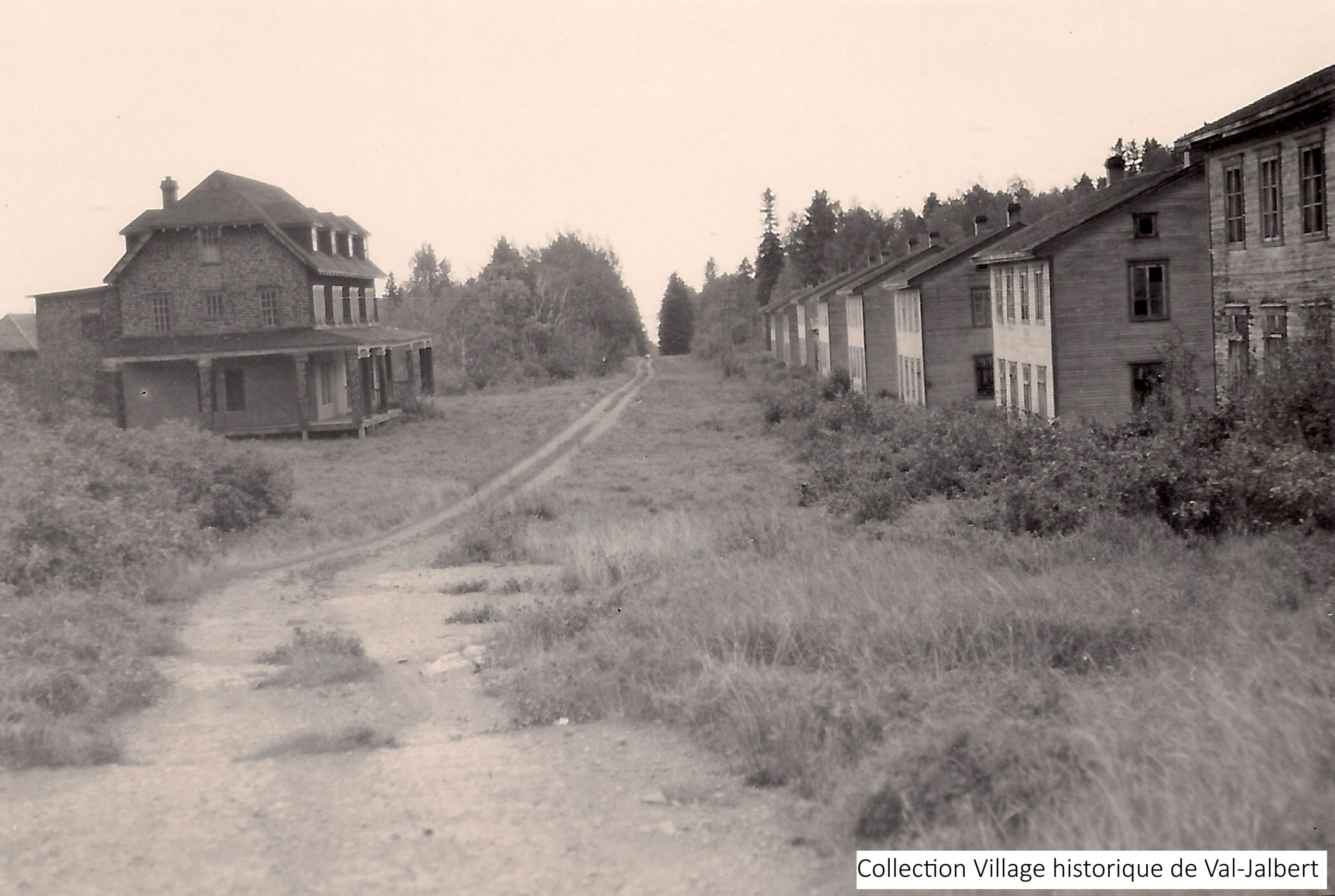
Since 1919, the Chicoutimi Pulp Company has been part of the Saguenay Pulp and Hydro Company. Seeking to increase its assets, the company issued shares, half of which were purchased by its competitor, Price Brothers, thereby allowing the latter to gain a seat on its board of directors in 1923. Following the resignation of J.E.A. Dubuc and faced with financial difficulties in an increasingly competitive market, the Chicoutimi Pulp Company was forced into bankruptcy. In March 1924, the company is liquidated, which affects the Saguenay Pulp and Hydroelectric Company, which loses its principal member. Consequently, the trustee in charge of the CPC’s bankruptcy took over management of the Val-Jalbert and Chicoutimi pulp mills. With demand for pulp declining and the plant facing a pulp surplus, the Val-Jalbert mill experienced its first shutdown from May 16, 1924 to December 9, 1925. Workers began leaving their homes (about thirty of them) to find work elsewhere.
In 1926, the Saguenay Pulp and Power Company and its subsidiaries (including CPC) came under the control of Québec Pulp and Paper Mills, a consortium of Quebec paper mills that included Price Brothers. Production picked up again in earnest, and the village reached a record population of 950 residents. This resurgence was short-lived, however, as the pulp industry was in decline and converting the plant into a paper mill would have required too much capital investment. The Val-Jalbert pulp mill closed permanently on August 13, 1927. On November 30, 1927, a new group, the Quebec Pulp and Paper Corporation, became the owner of the mill and its properties. It remained in charge until its bankruptcy on October 19, 1942. From 1927 to 1929, 220 people left the village, and a year later, 450 more left. By 1930, only 50 families remained. On August 18, 1949, the Government of Quebec seized all of Val-Jalbert’s facilities due to nonpayment of taxes. Management of the site, which was closed to visitors, was entrusted to the Ministry of Water Resources, which became the Ministry of Natural Resources in 1961.
Val-Jalbert's Second Life ─ Starting at 1960
Starting in 1960, the Quebec Province Tourism Office (later the Ministry of Recreation, Hunting, and Fishing) took over management of the site. Visitors were then admitted. Restoration and development work—such as trails, stairways, and road reinforcement—began. Between 19 and 60 et 1986, the renovation of several buildings was undertaken, including the mill, the hotel, the convent, the church, the rectory, and a few houses. The water and sewer systems, as well as the electricity, were restored within the village and at the mill.
In 1987, the site was transferred to the Société des établissements de plein-air du Québec (SÉPAQ), whose mission is to manage, operate, and develop the Val-Jalbert Historic Village for recreational and tourism purposes. Since 1998, the Domaine-du-Roy RCM has partnered with SÉPAQ in managing the site.
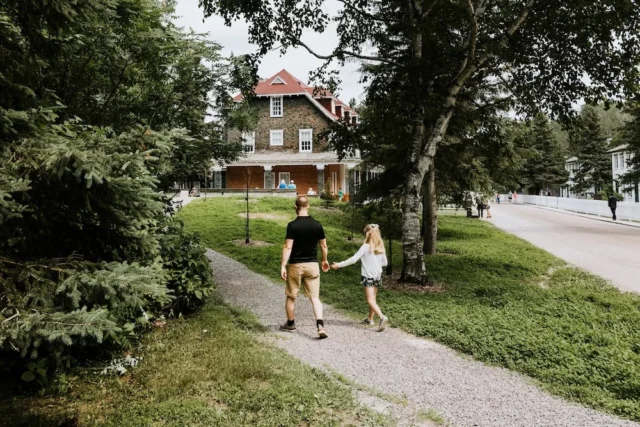
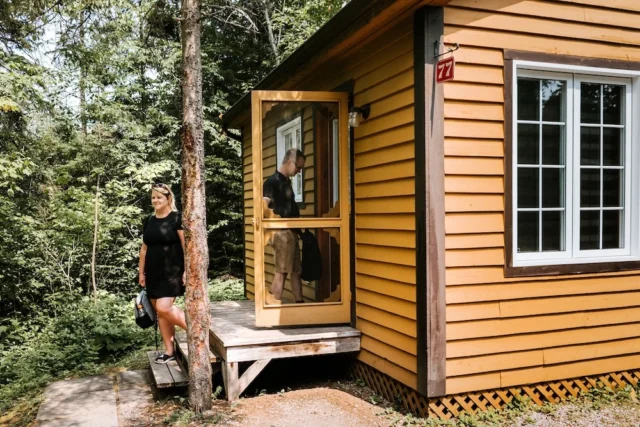
Currently, the site employs about 40 people annually, and twice that number during the summer season. More than 60 000 visitors come each year to enjoy a variety of activities, guided tours, theatrical reenactments of village life in days gone by, and accommodations at the hotel, in renovated houses, in mini-cabins, and at the campground. Annual revenue is approximately two million dollars. The Historical village of Val-Jalbert is now considered one of the region’s most beautiful attractions.
Val-Jalbert Today
In 2009, the Regional Park Corporation obtained approval from the Ministry of Culture, Communications, and the Status of Women (MCCF), Canada Economic Development, and the Domaine-du-Roy Regional County Municipality (RCM) — the site’s current owner ─ to fund a 19, 7 M$ project aimed at the comprehensive revitalization of the Historical village of Val-Jalbert, encompassing its infrastructure, interpretation, and the overall visitor experience at the site.
To achieve this, several buildings have been restored, the site’s natural setting has been enhanced, and the interpretive program has been improved. Innovation is evident in every aspect of the visitor experience, from the website all the way back home. Everything has been reviewed and modified to ensure a memorable visit. A modern visitor center has been built. Major investments have made it possible to restore, protect, and showcase the mill, where a new interpretive trail has been created. Visitors can now admire the magnificent Ouiatchouan Falls from a glass-bottomed platform. As part of the lodging package, comfortable rooms and high-end dining round out this superior experience.
These improvements have earned the Historic Village recognition at the Canadian Tourism Awards, the Quebec Tourism Awards, and from the Société des musées du Québec.
Val-Jalbert: A Fascinating Story to Discover
We invite you to pick up one of the books on the history of Val-Jalbert at the gift shop in the general store.